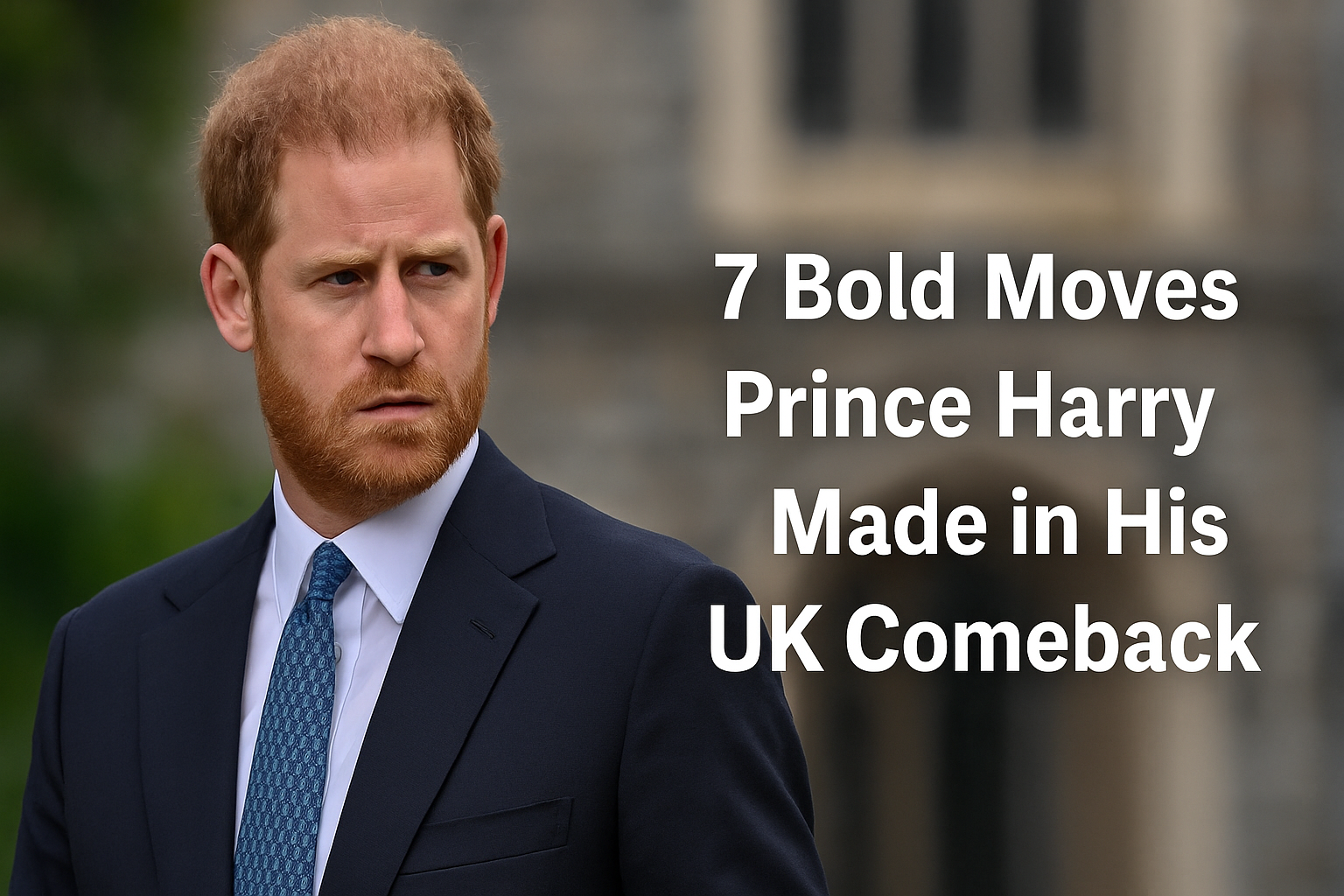
The Prince and the Palace — Tensions Beneath the Surface
Prince Harry’s UK return marks a turning point for the royal family. Explore five powerful shifts shaping the Prince’s role and the monarchy’s future.
The Prince’s Return Sparks Reflection
After years of distance and speculation, the Prince’s quiet return to the United Kingdom has once again placed the royal family in the global spotlight. His visit was short, but the impact has been far-reaching. To the public, it was a reunion years in the making; to the monarchy, it was a test of how much had truly changed.
This moment was more than just a family visit. It symbolized a turning point in the royal narrative — a reminder that even centuries-old traditions must evolve. The Prince has long represented both continuity and conflict within the monarchy, and his reappearance forces Britain to reconsider what loyalty, forgiveness, and relevance really mean in a modern world.
Once celebrated as the most approachable royal of his generation, the Prince became one of the most polarizing. Yet his latest return reveals a quieter, more introspective figure — someone shaped by experience, pain, and reflection. Whether viewed with admiration or skepticism, the Prince has again become a mirror of Britain’s shifting values.
The Prince’s Return — A Turning Point for the Royal Family
When the Prince landed in London under subdued circumstances, royal watchers expected stiff formality. Instead, his presence felt personal — a moment wrapped in nostalgia and uncertainty. Gone were the ceremonial welcomes and photographers lining the gates. This was not a grand return; it was a profoundly human one.
For the royal family, it was a reckoning. The monarchy has survived wars, scandals, and cultural revolutions, yet this was different. This time, the conflict was within — between brothers, between ideals, between past and future. The Prince’s arrival forced the institution to face questions it could no longer postpone.
Could a family that once represented unity heal from years of public division? Could a son who distanced himself from the Crown ever feel at home again? For the Prince, it was an emotional return; for the palace, it was a delicate balancing act.
Behind the scenes, royal advisers worked meticulously to manage optics. Every appearance was timed, every statement weighed. Even within that controlled environment, the Prince’s quiet charisma lingered. Courtiers reportedly described the mood as “respectful but uncertain.”
His visit reminded the monarchy that relevance cannot be inherited — it must be earned. As society evolves, so must the royals who serve it. The Prince’s return became an unspoken test of how adaptable the Crown truly is.
How the Prince’s Presence Changed Public Perception
The Prince’s homecoming divided public opinion but also sparked compassion. Some saw it as a necessary step toward healing, while others viewed it as another strategic move. Still, few could deny the emotions it stirred across Britain and beyond.
In pubs, coffee shops, and online forums, debates reignited. Was this the start of reconciliation or a temporary truce? For the younger generation, especially, the Prince’s vulnerability resonated. His story — marked by love, loss, and independence — mirrors the struggles of many who feel torn between tradition and self-expression.
Older citizens, meanwhile, wrestled with nostalgia. They remembered the Prince as the mischievous boy walking behind his mother’s coffin, then as the soldier who found purpose on the battlefield. Now, seeing him return as a man scarred by scrutiny and exile, many felt empathy tempered by caution.
For once, the conversation was less about blame and more about growth. The Prince’s return softened public discourse, suggesting that redemption within the royal sphere, though difficult, is not impossible.
The Role of the Media in Shaping the Prince’s Story
No royal event exists outside media coverage, and the Prince’s return was no exception. Newspapers captured every gesture, every subtle expression. While tabloids highlighted tension, reputable outlets focused on tone and symbolism.
Unlike previous visits, the Prince avoided interviews and statements. His silence itself became a headline. Analysts described it as strategic humility — a recognition that the public’s trust cannot be rebuilt through sound bites.
Commentators noted that the Prince’s calm composure contrasted sharply with the frenzy surrounding his earlier years. He has learned, perhaps painfully, that presence can speak louder than proclamation. And in an era of endless content, restraint has become a rare form of power.
Inside the Palace — The Subtle Shift in Dynamics
Royal insiders describe the atmosphere during the Prince’s stay as polite but charged. His conversations with senior members, though short, were described as sincere. One aide said, “It wasn’t about apologies. It was about understanding.”
The King, ever diplomatic, approached the reunion with caution. His affection for his son remains evident, but so does his commitment to stability. The Crown cannot be swayed by emotion alone. Yet those close to both men believe the meeting, though quiet, marked progress.
Behind closed doors, the Prince acknowledged that public perception had strained not just his reputation but the monarchy’s image as well. By returning, he extended a gesture of goodwill — one that may help reframe his role in the years ahead.
Within the palace, some staff viewed his return with hesitation, fearing renewed media scrutiny. Others, particularly younger aides, saw it as a chance to modernize the royal narrative. “He’s still a part of this story,” said one source. “And that story needs to change.”
The Prince’s Emotional Journey Home
Every journey back home is layered with emotion, and for the Prince, this one carried the weight of years. Walking through familiar gates likely stirred memories of his mother, his childhood, and his early sense of duty.
Time abroad has reshaped him. Those who interacted with the Prince during his visit described a man more grounded, less defensive, and more thoughtful. He no longer seeks approval; he seeks peace. That subtle change has shifted how even skeptics perceive him.
The Prince spent time reflecting on what legacy means outside palace walls. His distance from royal life gave him perspective — both freedom and understanding. He now knows that identity built on defiance alone cannot sustain purpose. His challenge lies in blending independence with empathy, individuality with shared history.
Why the Prince’s Story Mirrors Britain’s Own Transformation
Modern Britain is evolving, and so is its monarchy. Citizens now expect transparency over secrecy, action over symbolism. The Prince, often unintentionally, personifies this shift.
Once, being royal meant observing distance; now, it demands approachability. The Prince’s open struggle with identity and belonging mirrors the nation’s search for relevance amid tradition.
In many ways, his journey reflects Britain’s broader cultural arc — from reverence to realism. The Prince’s willingness to confront flaws rather than conceal them resonates with a generation disillusioned by perfection. His flaws, paradoxically, have made him more human — and therefore, more relatable.
Rebuilding Trust — The Prince’s Quiet Redemption
Trust is the currency of monarchy, and for the Prince, regaining it requires consistency more than ceremony. His recent actions, understated yet deliberate, suggest an awareness that public opinion cannot be managed; it must be earned.
The Prince’s work with charities and veterans continues quietly. He appears more interested in service than spotlight, a shift that signals maturity. Even critics admit that his demeanor feels steadier.
Insiders note that his tone, once defensive, has softened. In private, he focuses less on vindication and more on growth. The King reportedly appreciates this new perspective, recognizing in his son the resilience required to rebuild bridges.
The Prince’s approach stands as a blueprint for modern reconciliation — firm, patient, and genuine. It reminds the public that redemption, royal or otherwise, is a process, not an event.
The Prince’s Influence on Future Royals
Younger royals closely observe the Prince’s journey. His decision to step back from official duties reshaped how future generations view service. It taught them that duty can coexist with individuality.
Prince William and Princess Catherine, representing continuity, embody one form of modern monarchy — structured, disciplined, and traditional. The Prince, by contrast, represents evolution — the courage to question, adapt, and redefine.
Both paths are vital. Together, they represent two halves of a new royal equation: tradition that stands firm, and change that keeps it alive. In this way, the Prince’s controversial past has become an unlikely gift — a catalyst for reflection and renewal.
Behind the Scenes — The Prince’s Private Life
Away from cameras, the Prince lives a quieter existence focused on family and purpose. His wife’s influence has stabilized him; his children, he says privately, are his anchor. Those close to him describe laughter returning to his voice, a lightness absent in previous years.
He spends more time outdoors, often engaging in conservation work. The Prince’s passion for environmental issues mirrors his father’s, though approached differently — less ceremonial, more personal.
Friends say that while he misses aspects of royal duty, he has found meaning in autonomy. “He’s at peace with who he is,” one confidant shared. “And that peace took years to earn.”
The Prince’s Relationship with the King
The father-son relationship remains central to the monarchy’s public image. Historically formal, it has matured into something gentler. The King, mindful of legacy, sees in the Prince both frustration and hope.
Their latest meeting reportedly avoided past grievances. Instead, they discussed shared causes — sustainability, veterans, and the role of compassion in leadership. The Prince, in turn, expressed renewed respect for his father’s lifelong dedication to service.
Observers believe this thawing relationship reflects a broader shift in royal culture — away from stoicism and toward understanding. It shows that within even the most rigid institutions, empathy still has a place.
The Public’s Renewed Interest in the Prince
Ironically, the Prince’s absence made the public more curious. His return reignited fascination not just with his choices but with the monarchy’s adaptability.
Younger Britons, skeptical of hierarchy, now view him as a relatable figure navigating pressures they understand — media judgment, personal growth, and family conflict. His openness about emotion resonates in a culture that increasingly values vulnerability over perfection.
Older citizens, once harshly critical, now express cautious respect. They see a man transformed by adversity — someone willing to confront his past and face the institution that defined him.
The Prince’s story has become not one of rebellion but resilience.
Why the Prince’s Return Matters for the Monarchy
Every monarchy depends on renewal. Without it, reverence turns into nostalgia. The Prince’s reappearance offered something invaluable — perspective.
He reminded the Crown that strength lies not in hiding weakness but in acknowledging it. His personal growth parallels the monarchy’s slow but steady evolution.
By returning, the Prince demonstrated that grace can exist alongside independence. His presence reaffirmed that even when fractured, family bonds can still heal under the weight of duty and love.
The monarchy, often accused of rigidity, now faces an opportunity to rebuild public trust through transparency and humility. And in that mission, the Prince’s journey may prove essential.
The Symbolism of the Prince’s Journey
In royal storytelling, gestures matter more than grand speeches. The Prince’s understated return was not a spectacle but a symbol — one that spoke to the quiet endurance of family ties.
His willingness to step back into Windsor, knowing the scrutiny awaiting him, showed courage. For the institution, it was a subtle reminder that progress often begins with discomfort.
Even without official status, the Prince continues to influence the monarchy’s image. His actions suggest a future where grace and honesty replace formality and silence.
The lesson is clear: the monarchy’s survival depends not on perfection, but on its ability to evolve.
The Prince’s Reputation Through Generational Eyes
Public opinion about the Prince often depends on age. For younger audiences, he represents courage — a man who challenged an outdated system. For older Britons, he stirs nostalgia for the royal family’s earlier unity. This contrast reveals how the monarchy’s image evolves with each generation, and how the Prince now bridges two eras that see duty in very different ways.
How the Prince’s Distance Redefined Royal Duty
During his years abroad, the Prince discovered that distance can clarify purpose. Away from royal routine, he learned that service is not measured by ceremony but by sincerity. His return proved that influence can survive without titles, and that modern royalty must earn relevance through authenticity.
The Prince’s Relationship with the British Public
The Prince’s bond with the public has always been complex — affectionate yet skeptical. Each reappearance invites both curiosity and criticism. Still, his candor about mental health, veterans, and family conflict has made him an emblem of honesty within an institution long defined by silence.
The Prince’s Connection to His Late Mother
No discussion of the Prince’s story feels complete without acknowledging his mother’s lasting influence. Her compassion and defiance shaped his worldview. Many observers believe that returning to Britain allows the Prince to reconnect not only with his family but with the legacy she left behind — one grounded in empathy and courage.
The Prince and the Changing Face of Leadership
Modern leadership requires empathy, and the Prince embodies that shift. Unlike earlier royals who valued restraint, he embraces openness. His willingness to share emotion signals a broader evolution: a Crown that leads not by distance but by understanding.
Lessons in Resilience from the Prince’s Journey
Through every controversy, the Prince has shown endurance. He has faced judgment from tabloids, isolation within his family, and public skepticism. Yet, his continued return to Britain suggests a quiet determination to rewrite his story through persistence rather than pride.
The Prince’s Role in the King’s Modern Vision
King Charles III envisions a smaller, more efficient monarchy. Within that plan, the Prince plays an unexpected role — not as an active participant, but as proof that reform is possible. His journey highlights the importance of evolution even within hereditary systems.
The Prince’s Influence on Royal Communication
Palace communication has long been formal and cautious. The Prince’s direct, conversational approach has forced courtiers to rethink how the royal family speaks to the world. Transparency is now seen not as weakness but as a necessity — a lesson that began with the Prince’s candor.
The Prince’s Relationship with the Military
The Prince’s time in the armed forces continues to shape his identity. Many veterans still express loyalty to him, admiring how he used his platform to raise awareness about trauma and recovery. His continued advocacy reflects a deep respect for those who served beside him and reinforces his credibility beyond palace walls.
How the Prince’s Return Impacts Britain’s Global Image
Internationally, the Prince’s return has revived interest in the monarchy. In America, where he has built a second life, media coverage shifted from gossip to reflection. Across Europe, commentators described him as a symbol of cultural transition — a bridge between formality and freedom.
The Prince and the Challenge of Privacy
Balancing public duty with personal privacy remains one of the Prince’s greatest struggles. His return renewed debate about where royal life ends and private life begins. By maintaining silence rather than issuing statements, he demonstrated that boundaries, once broken, can still be redrawn.
The Prince’s Path Forward
The Prince may never resume complete royal duties, but his relevance endures. He represents both the monarchy’s wounds and its healing. His next chapter will likely blend public service with private purpose, rooted in authenticity rather than obligation.
What makes the Prince’s journey compelling is its universality. Beneath the titles and headlines lies a story about identity, forgiveness, and growth — a story millions can relate to.
In accepting change, he has become an agent of it. The Prince’s quiet evolution reflects a monarchy learning humility — an institution no longer untouchable but undeniably human.
As the royal family moves forward, the Prince’s choices will continue to influence its rhythm. His return reminds the world that tradition is not the opposite of progress — it is its foundation.
Through calm resilience and honest reflection, the Prince shows that even in the most ancient institutions, renewal begins one step at a time. His story is not about loss; it’s about learning how to move forward without forgetting where you started.
And in that journey, the monarchy — and perhaps Britain itself — may find the balance it’s been searching for.
Prince Harry’s return to the UK clarified – exclusive
“6 Powerful Highlights from Prince William’s New Mental Health Video”
About the Author