Beckham’s Journey from Football Glory to Royal Honor
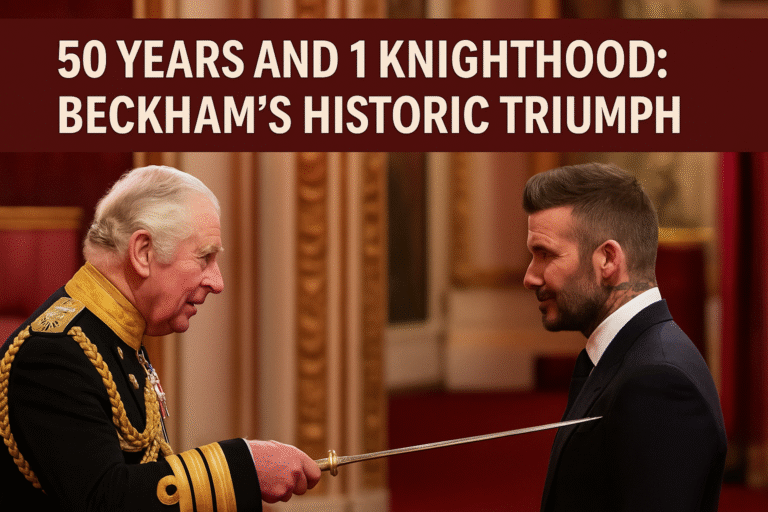
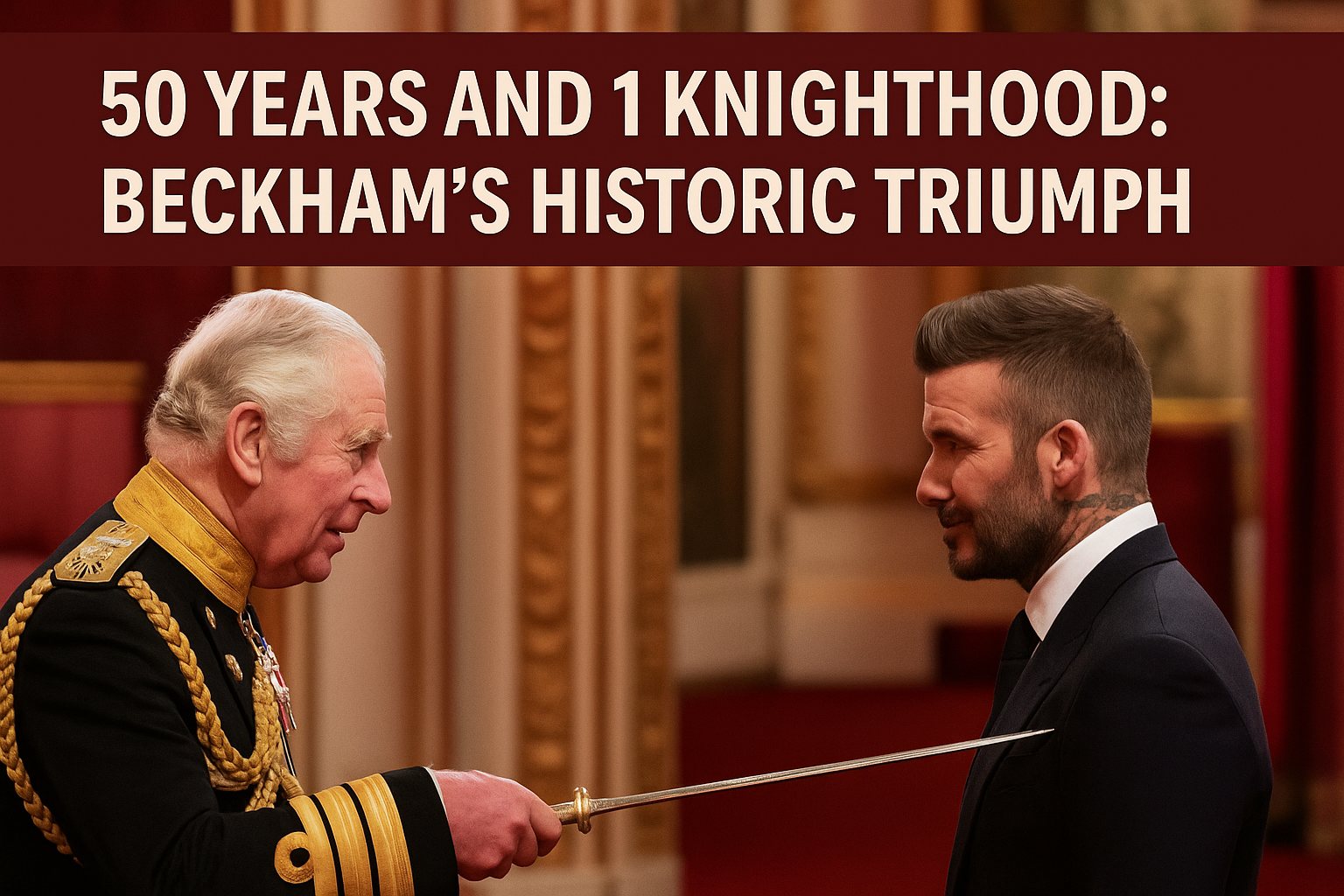
Beckham receives his long-awaited knighthood from King Charles III — a historic triumph celebrating five decades of passion, resilience, and national pride.
50 Years and 1 Knighthood: Beckham’s Historic Triumph
For years, the British public speculated about when Beckham would finally receive the honor that seemed destined for him. Now, at Windsor Castle, in a ceremony filled with formality and quiet emotion, King Charles III placed the insignia of knighthood upon the former England captain. The moment, decades in the making, was as much a reflection of national sentiment as it was of personal achievement.
The event represented a convergence of sport, culture, and service. Moreover, it marked the culmination of a journey that began on a modest playing field in east London and ended beneath the gilded arches of Britain’s most iconic royal residence.
The Moment at Windsor Castle
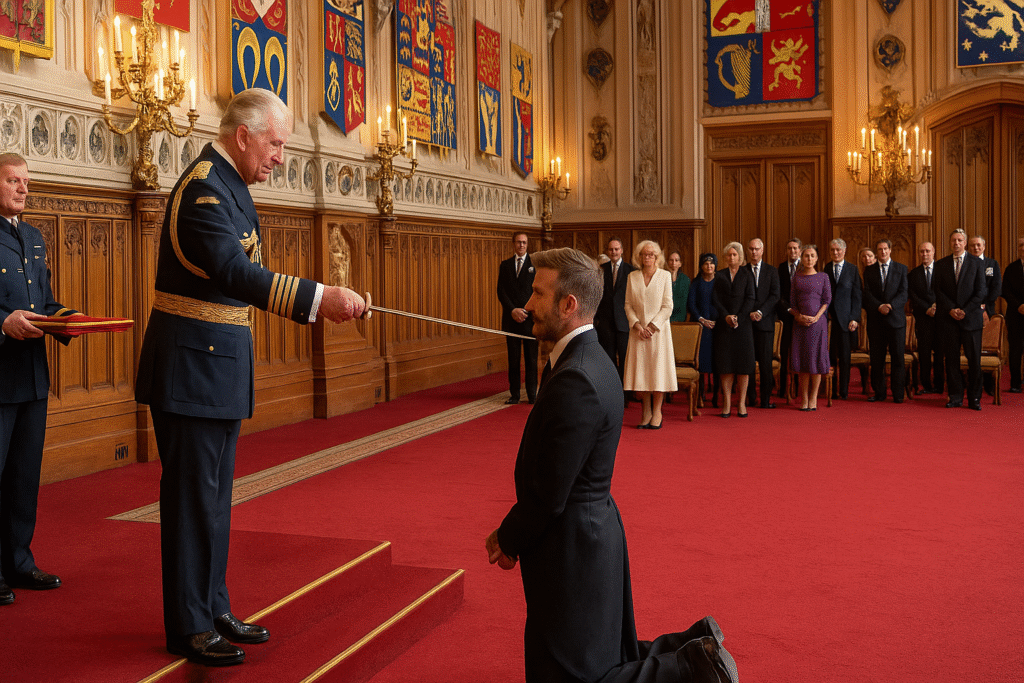
The investiture, held in the majestic St George’s Hall, was attended by dignitaries, former teammates, and members of Beckham’s family. Photographers gathered outside the castle walls, while television crews broadcast the moment live to millions of viewers around the world; therefore, what had once been speculation became a global headline within minutes.
King Charles, himself a lifelong supporter of public service and charitable causes, spoke warmly as he conferred the honor. Observers noted the brief but genuine smile exchanged between the monarch and the football icon — a moment of mutual recognition between two men who have, in different ways, served the United Kingdom’s public identity.
However, beyond the ceremony’s formality, there was something unmistakably emotional about the scene. Beckham, known for composure under pressure, blinked rapidly as the knighthood was announced. The cameras captured his eyes glistening, not with pride alone but with gratitude.
A Journey from Working-Class London to Royal Recognition
Born in Leytonstone in 1975, David Robert Joseph Beckham’s ascent mirrored the aspirations of a generation. His father, a kitchen fitter and devoted Manchester United fan, passed down a passion for football that became both a compass and a calling.
Throughout his career, Beckham was never simply an athlete. He was a brand, a cultural force, and — at times — a national lightning rod. Nevertheless, despite fame and fortune, his public image retained a distinctly British modesty. As a result, many saw this knighthood not as celebrity reward but as the culmination of genuine contribution to sport and charity.
Moreover, his work extended far beyond the pitch. For over two decades, he has served as a UNICEF Goodwill Ambassador, focusing on children affected by conflict and poverty. His 7 Fund for UNICEF continues to support programs that empower young girls through education and protection initiatives.
Therefore, the award acknowledges not only his 20 years in professional football but also his long-term humanitarian influence — an intersection of fame and responsibility that defines modern public service.
Decades of Delay and Debate
The road to Windsor was not without hesitation. For nearly ten years, public curiosity surrounded the absence of an honor many assumed inevitable. Commentators debated whether tax-related controversies or political sensitivities had delayed the process. However, those who know the Honours Committee’s methods insist that timing often aligns with broader public sentiment rather than celebrity expectation.
As a result, the 2025 announcement arrived with the weight of anticipation. Newspapers described it as “justice for a national treasure.” Supporters flooded social media with messages celebrating the overdue recognition. Even some critics, previously skeptical of star power in state honors, admitted the moment felt earned.
Meanwhile, royal insiders revealed that King Charles personally approved the nomination, recognizing Beckham’s sustained charity record. The decision, they said, reflected a conscious effort to align royal honors with long-term integrity rather than short-term popularity.
From Football Icon to National Symbol
Few athletes embody British identity quite like Beckham. His career, from his 1996 halfway-line goal for Manchester United to his final appearance for Paris Saint-Germain, paralleled Britain’s transformation into a global cultural powerhouse.
At Old Trafford, he represented discipline and precision. At Real Madrid, he embodied global appeal. And with England, he epitomized redemption — particularly after that infamous 1998 World Cup red card against Argentina. In the years that followed, he turned national vilification into admiration through persistence and grace.
Consequently, when he knelt before the King, the nation saw not a celebrity but a story of resilience. The knighthood validated decades of perseverance and professionalism. It also acknowledged his unique ability to unite class divides — adored in working-class pubs and elite circles alike.
The Royal Connection and Public Symbolism
Ceremonially, knighthood represents duty and moral contribution to society. Yet, in a broader sense, this honor reflects the monarchy’s evolving relationship with modern Britain. King Charles III has often championed figures who bridge heritage with progress — individuals who embody traditional values while resonating with younger generations.
In this regard, Beckham’s story aligns perfectly. Despite his international lifestyle, he has consistently embraced British identity, often seen queuing with the public to pay respects to Queen Elizabeth II during her lying-in-state. That moment of humility captured hearts and perhaps reminded the Palace that public service takes many forms.
Moreover, his relationship with the royal household is not new. Over the years, he has attended numerous charity galas and state events, constantly navigating royal protocol with polished respect. The knighthood therefore feels less like a surprise and more like a formal affirmation of a long-standing connection.
Media Reaction and Public Sentiment
As expected, the British press devoted front-page coverage to the event. Headlines described it as “the culmination of a golden career.” Social-media timelines filled with images of Beckham bowing before the monarch, while television commentators replayed his early-career highlights alongside footage of the Windsor ceremony.
Furthermore, the coverage’s tone was notably warm. Even outlets known for cynicism adopted a tone of reverence. The Times wrote that the honor “felt like closure — not only for Beckham but for Britain’s sporting conscience.” Meanwhile, The Guardian emphasized the symbolic passing of generational pride, noting how his knighthood coincided with renewed interest in youth sports development programs.
However, the global response extended far beyond the UK. Major U.S., European, and Asian networks broadcast the ceremony, underscoring how Beckham’s fame transcends nationality. Analysts pointed out that few modern figures could command such simultaneous coverage across continents.
Family Pride and Private Emotion
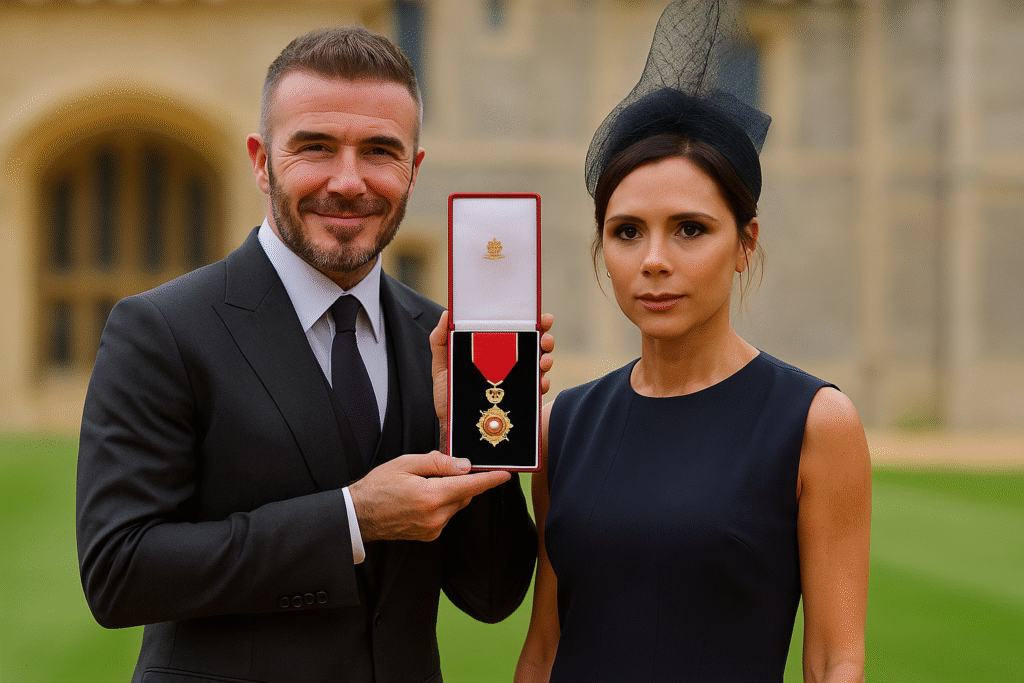
Among the day’s most memorable images were those featuring Beckham’s family. Victoria Beckham, elegant and composed, looked on proudly. Their four children — Brooklyn, Romeo, Cruz, and Harper — stood nearby, capturing the moment on their phones, as millions watched online.
Observers noticed subtle gestures that spoke louder than words: Victoria’s hand briefly touching her husband’s shoulder as he rose, Harper’s wide smile breaking royal protocol with youthful spontaneity. Consequently, these personal details humanized the grandeur, turning a state occasion into a family memory.
Later, in a brief interview, Beckham admitted the emotion had surprised him. “It’s overwhelming,” he said softly. “You dream of playing for your country, but you never dream of this. It’s something I’ll cherish for the rest of my life.”
Philanthropy at the Heart of Honor
While football made him famous, philanthropy secured his knighthood. Over two decades, Beckham has leveraged his platform for humanitarian impact. Through UNICEF and various foundations, he has raised millions for disaster relief, education, and children’s welfare.
Moreover, his charitable efforts have extended to the domestic front. He has supported veterans’ initiatives, youth sports programs, and local hospital charities. Each campaign, though often low-profile, reinforced his image as a figure who leads through action rather than publicity.
Therefore, the honor stands not merely as recognition of fame but as a statement of values — compassion, discipline, and consistency. These attributes align seamlessly with King Charles’s vision of modern knighthood as service through influence rather than inheritance.
The Global Legacy of a Modern Knight
In global terms, Beckham’s knighthood enhances Britain’s soft power. His name carries recognition in markets from Tokyo to Toronto. Consequently, his association with the monarchy strengthens the nation’s cultural reach, promoting British identity through sport, fashion, and philanthropy.
Furthermore, the timing reinforces Britain’s image of inclusivity. In honoring a figure who rose from modest beginnings, the Palace signals that merit remains central to the honours system.
As one diplomatic correspondent observed, “This is the monarchy acknowledging the power of cultural diplomacy. Beckham is as effective an ambassador as any envoy, precisely because he inspires emotion rather than obligation.”
Criticism and Context
Not everyone greeted the announcement without reservation. A handful of commentators questioned whether celebrity culture continues to overshadow less visible forms of service. However, defenders argue that public influence itself can constitute service when wielded responsibly.
In this context, Beckham’s example demonstrates how fame can facilitate philanthropy. Moreover, his long-term commitment contrasts sharply with fleeting social-media advocacy. Therefore, even sceptics concede that his record speaks louder than his celebrity.
Meanwhile, government officials emphasized that every nomination passes rigorous scrutiny. The Cabinet Office confirmed that honorees must meet criteria for sustained service and integrity. Consequently, the decision carried institutional weight, not simply public approval.
The Ceremony’s Subtle Symbolism
Beyond titles and medals, ceremonies like this one serve as cultural mirrors. The knighting of a sportsman reflects how Britain now defines greatness. No longer confined to military or political fields, modern heroism includes those who shape global goodwill through talent and persistence.
Observers described how, at the end of the investiture, the orchestra played a gentle arrangement of Jerusalem. The hymn’s familiar refrain — “And did those feet in ancient time…” — resonated through the hall, drawing quiet tears from attendees. It was a reminder that British identity, for all its evolution, still cherishes the spirit of endeavor.
Therefore, Beckham’s inclusion in that tradition marks both continuity and change: a bridge between classic ceremony and modern celebrity.
Reaction from the Sporting World
Messages of congratulations poured in from athletes and clubs worldwide. Former teammate Gary Neville wrote that “no one has represented English football with more grace.” Real Madrid issued a statement celebrating the honor as “a triumph for professionalism.” Even FIFA released an official note recognizing his “exceptional contribution to the game.”
Furthermore, young players expressed admiration on social media, crediting Beckham for inspiring their careers. Academy coaches reported renewed interest from children eager to “bend it like Beckham” — proving that nostalgia still fuels the future of the sport.
As a result, his knighthood resonated not only as a personal milestone but also as a rejuvenation of football’s moral narrative — a reminder that discipline, dedication, and humility remain cornerstones of greatness.
A Broader Reflection on Fame and Duty
In an age when celebrity often feels transient, Beckham’s enduring relevance underscores a rare combination of talent and integrity. He has navigated global fame without alienating authenticity. Moreover, his willingness to align personal brand with public service represents a model increasingly valued in modern Britain.
Analysts note that the monarchy’s continued engagement with cultural icons keeps the Crown in touch with contemporary audiences. Consequently, each honor awarded to such figures extends the institution’s social relevance.
However, this interdependence also carries risk. The more monarchy embraces celebrity, the more it must balance glamour with gravity. In Beckham’s case, that balance appears intact — a synergy of popularity and purpose.
Looking Ahead
Following the ceremony, speculation immediately turned to future roles. Could Sir David Beckham take on new ambassadorial responsibilities? Insiders suggest that he may expand his charitable partnerships under royal patronage, particularly in youth development and international sports diplomacy.
Therefore, the knighthood might represent not an endpoint but a new beginning — a transition from national hero to institutional figure.
Meanwhile, public interest shows no sign of waning. Documentaries, interviews, and retrospectives are already in production, ensuring that the story of his historic triumph continues to inspire.
The Future of a Modern Knight
Although the ceremony at Windsor signified a closing chapter in sporting history, it also opened another — one rooted in service rather than competition. Sir David’s next decade could define how athletes transition into global statesmanship.
Already, whispers from the sports diplomacy community suggest that Britain intends to utilize his global reputation in soft-power initiatives. Because his name carries credibility in countries where British politics does not, his involvement could extend the reach of humanitarian diplomacy far beyond the realm of football.
Furthermore, the Palace reportedly supports this idea. Sources close to the royal household hint that future joint engagements may focus on youth empowerment, environmental sustainability, and international education campaigns. These areas align perfectly with King Charles III’s lifelong advocacy for community development and climate responsibility.
As a result, Sir David’s platform could evolve into a partnership that blends sport, diplomacy, and social impact. In many ways, this represents the natural continuation of his lifelong mission — using influence not for image but for purpose.
A National Moment of Reflection
While the spotlight focused on Sir David, the event also served as a broader reflection of what modern Britain celebrates. Unlike older times, when knighthood was reserved for aristocrats, today’s honors represent the democratization of excellence. Ordinary citizens can see in his story the validation of perseverance, skill, and service.
Consequently, newspapers across the political spectrum framed the knighthood as a unifying moment. For one weekend, front pages replaced division with admiration. Political commentators admitted that the country, often fractured by debate, seemed momentarily whole.
Moreover, sociologists view this reaction as significant. They argue that Britain’s collective joy over the ceremony suggests a continued need for shared symbols of pride. In an era defined by cynicism, such symbols remind people that achievement rooted in sincerity still matters.
At the same time, this renewed optimism may influence future royal decisions. The success of the ceremony demonstrated how honors rooted in emotional connection can rekindle public trust in traditional institutions. Therefore, it may guide future honorees — encouraging the Palace to continue recognizing individuals whose fame is matched by substance.
Conclusion
“50 Years and 1 Knighthood” captures more than a numerical milestone; it encapsulates the spirit of perseverance that defines both man and nation. Through triumphs and trials, Beckham has remained a constant figure of British identity — stylish yet sincere, global yet grounded.
Ultimately, his historic recognition at Windsor Castle affirms a truth that transcends sport: genuine service, given consistently over time, commands respect beyond fame. Therefore, his knighthood is not merely a reward; it is a reflection of character forged in the public eye and tempered by humility.
As the ceremony concluded and the crowds outside erupted in applause, one could sense that Britain was not only celebrating a football legend but also reaffirming faith in its own enduring values — honor, effort, and heart.
The Emotional Undercurrent: Britain’s Relationship with Its Icons
Every era defines its heroes differently. In post-war Britain, valor was measured on the battlefield. In the late 20th century, it was measured on the pitch. Yet today, heroism extends to compassion, responsibility, and emotional intelligence — values embodied by figures like Sir David.
Therefore, this knighthood was not merely about medals or fame. It became a collective expression of Britain’s yearning for integrity in leadership. At a time when institutions face distrust, his story offered reassurance that success and decency can coexist.
Moreover, cultural historians describe his public image as a mirror of the national psyche. His early mistakes reflected youthful rebellion, while his later conduct represented maturity and redemption. Consequently, this evolution parallels Britain’s own desire for reinvention — proud of its tradition yet willing to embrace vulnerability and change.
The emotional connection between public and player has always been strong, but this honor sealed it permanently. For the generation that watched him rise, the ceremony symbolized closure. For those who grew up knowing him only as a global entrepreneur, it reintroduced the humility that made him beloved in the first place.
David Beckham’s close friendship with the royal family – all the best photos
“Prince Andrew: 5 Startling Truths How the Palace Disowned”
About the Author