The Sovereign Grant funding bump is once again putting the British monarchy’s finances under the spotlight. At £132.1 million for 2025–26, the latest figure marks one of the highest levels of public funding the Royal Household has ever received.
Right from the beginning, the Sovereign Grant funding bump raises a simple but powerful question: where does all this money actually go, and why does it rise so sharply?
For many taxpayers, the numbers feel abstract until someone breaks them down. When you look closely, you see a mix of historic tradition, modern property profits, and a massive infrastructure overhaul at Buckingham Palace. This creates a funding model that feels both complex and controversial.
In this article, we unpack how the system works, why costs keep rising, and what the latest Sovereign Grant funding bump really means for the public purse.

Table of Contents
What Is the Sovereign Grant Funding Bump?
The Sovereign Grant is the UK’s official system for funding the monarchy’s public duties. It replaced the old Civil List in 2012 and introduced a promise of transparency and consistency.
Instead of managing multiple separate budgets, the monarchy now receives a single annual payment from the Treasury. The government uses this money to cover several core costs, including:
- Staff salaries
- Official travel
- Maintenance of royal palaces
- State events and ceremonies
Security costs do not fall under the Sovereign Grant. The government handles them separately.
The funding links directly to profits from the Crown Estate, a large portfolio of land and assets that an independent body manages on behalf of the nation. This link drives changes in funding levels and fuels ongoing debate around the Sovereign Grant funding bump.
How the Sovereign Grant Funding Bump Works
The Sovereign Grant funding bump does not happen randomly. The system calculates it using a percentage of Crown Estate profits from two years earlier.
When Crown Estate profits rise, the grant usually increases. When profits fall, the system should reduce the payment.
In practice, the situation does not always work so smoothly.
In recent years, the Crown Estate has recorded record-breaking profits. Offshore wind leasing has driven much of this growth. At the same time, major renovation projects—especially at Buckingham Palace—have increased costs and pushed funding higher, even if only temporarily.
As a result, the latest Sovereign Grant funding bump has reached £132.1 million. Officials expect adjustments in the coming years, but the current level remains elevated.

Where the Sovereign Grant Funding Bump Money Is Actually Spent
One of the most important questions is not how much the monarchy receives, but where the money goes.
Official breakdowns show how the Sovereign Grant funding bump splits across three major areas:
1. Palace Maintenance and Protection
More than half of the grant supports royal residences. The Royal Household uses this money for electrical rewiring, structural repairs, and preservation work across buildings such as Buckingham Palace and Windsor Castle.
2. Staff and Administration
The Royal Household spends around £33.7 million on staff who support royal duties. This includes private secretaries, communications teams, and household staff who manage day-to-day operations.
3. Official Travel and Duties
Royal travel creates another major expense. A single state visit abroad can cost hundreds of thousands of pounds once flights, logistics, and coordination are included.
For example, the King and Queen’s visit to Rome cost nearly £127,000 in flights alone.
These costs help explain why the Sovereign Grant funding bump continues to attract public attention.
Buckingham Palace Renovation Costs Explained
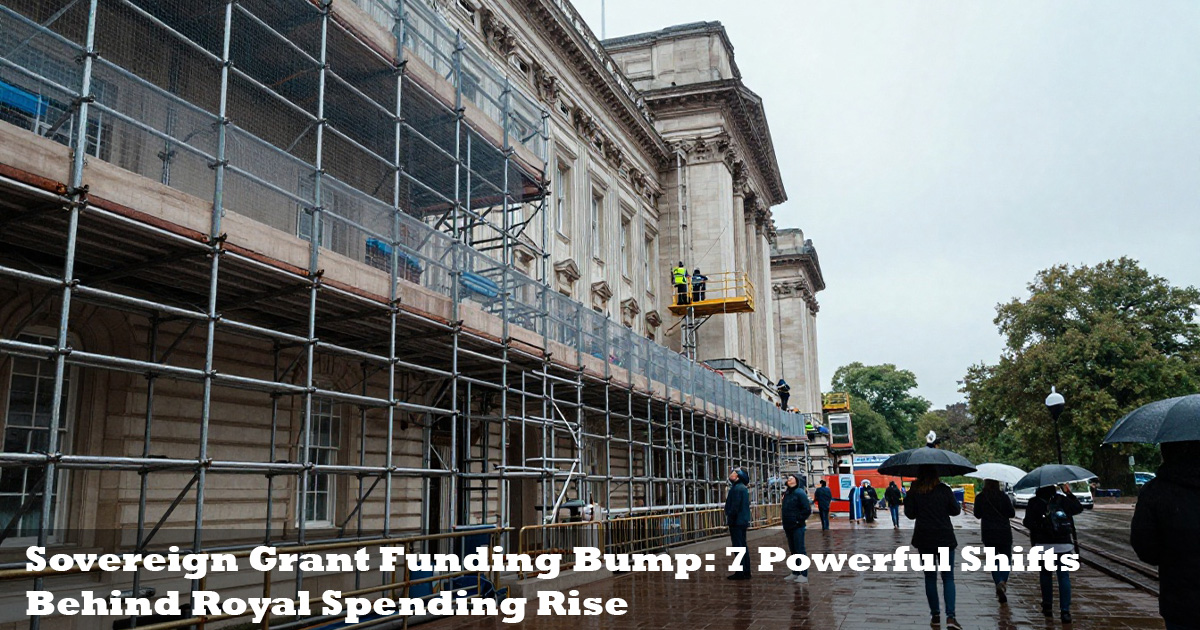
A major driver behind the current Sovereign Grant funding bump is the ongoing Buckingham Palace renovation.
The Royal Household manages this decade-long £369 million overhaul to modernise infrastructure that has not seen major upgrades since the 1950s.
Key upgrades include:
Structural safety improvements
Electrical rewiring across the palace
Plumbing replacement
Heating system overhaul
This renovation alone accounts for tens of millions added to annual budgets.
In fact, a final £40.3 million payment is included in the 2026–27 grant, meaning the spike is temporary—but significant.
Without this project, the Sovereign Grant funding bump would be noticeably smaller, though still higher than a decade ago.
Crown Estate Profits and the Funding Mechanism
At the heart of the system is the Crown Estate, one of the UK’s largest property portfolios.
Recently, it recorded profits of over £1.1 billion, largely driven by offshore wind energy leases. This surge directly influenced the Sovereign Grant funding bump, since the grant is tied to these profits.
However, the system has a built-in complexity.
When Crown Estate profits later dropped to around £487 million, the grant did not fall proportionally. Critics argue this creates a “ratchet effect,” where funding rises easily but rarely decreases at the same pace.
Supporters say the mechanism ensures stability and avoids sudden cuts that could disrupt royal operations.
Either way, the Sovereign Grant funding bump sits at the center of a long-running debate about fairness and transparency.
Transparency, Taxes, and Public Debate
In response to ongoing scrutiny, the Royal Household has increased financial transparency.
For the first time, King Charles voluntarily disclosed his tax payments—around £12.9 million for the year. The Prince of Wales also revealed millions in Duchy-related tax contributions.
While these disclosures are not legally required, they are seen as an attempt to modernize the monarchy’s financial image.
Still, public debate continues. The Sovereign Grant funding bump is often discussed alongside questions like:
- Should royal funding be capped?
- Is the Crown Estate model outdated?
- Does the public get enough value in return?
These questions are unlikely to disappear anytime soon.

What Happens After the Sovereign Grant Funding Bump Reset?
Looking ahead, the grant is expected to settle at around £99.9 million annually for five years after the current renovation cycle ends.
This figure is presented as a reduction, but in reality, it represents a new baseline that is roughly double pre-renovation levels.
So even when the peak spending phase ends, the effects of the Sovereign Grant funding bump will remain visible in long-term public funding levels.
Whether this stabilizes future costs or leads to further increases will depend on Crown Estate performance and future policy decisions.
About the Author